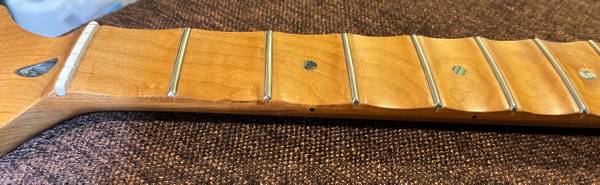
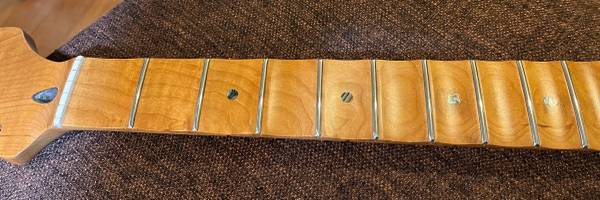
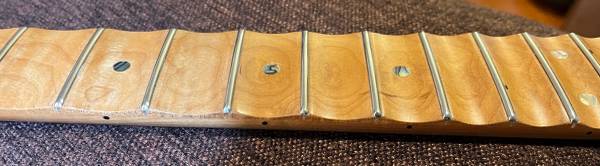
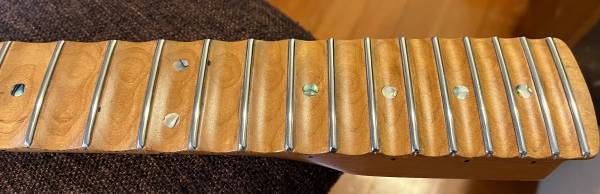
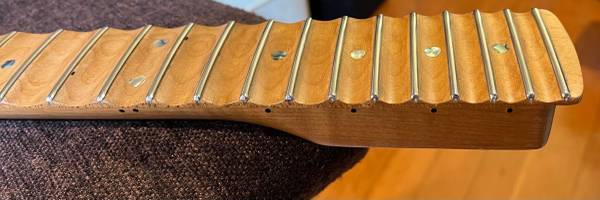
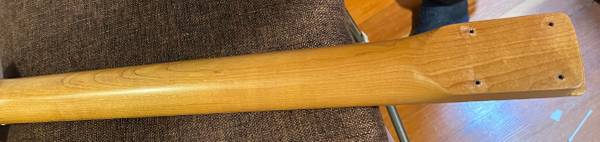
Roasted (not tinted) maple neck for Fender (or clone) strat / stratocaster (used about 30 or 40 hours on Squier Classic Vibe 70's Stratocaster.
This neck already has:
- leveled fretboard, dressed frets -- on the Squier Classic Vibe 70s I bought it for, this neck was quiet at 5/64 (low E) - 4/64 (high E) at the twelfth fret. There's a little fret sprout at the heel, either from the dry weather or from being conservative when addressing fret ends (I personally would readdress that if keeping the neck, but I'm picky and expect all my fretboards to rate a "5 out of 5" on the Phil McKnight scale).
- Tusq XL (self-lubricating) nut and Tusq string tree (also self-lubricating) -- both are included, the nut is intonated, and the slots are low enough that the 1st fretted note is in tune with the third fretted note, while being high enough that there's zero fret buzz when digging in hard on the open low strings. These are big plusses as with these necks often you get a plastic or synthetic nut even when you're promised bone, and the slots are always very far from being intonated.
- lacquered with nitrocellulose, the finish is basically satin finish in feel (aerosol refinish done by me). Frets were taped off when the neck was sprayed. I am a professional woodwind technician, and have plenty of clear nitro on hand at all times. A few notes are in line here.... The coverage is lighter than on manufactured finishes. I was only trying to seal the wood to minimize moisture exchange during weather changes. There are a couple of bare spots (around the size of a sunflower seed shell, each) on the headstock where lacquer pulled off when I taped off around the nut to file the nut slots (they are filed for 08 sets through 10 sets, you may want to retouch for heavier string gauges). There is also one smaller spot in the scallop of the first fret where a tiny spot lifted up when taping off for fretwork (visible in 1st/main listing photo). The area with the blemishes from lacquer pulling up with tape are in the 3rd photo (of the headstock) but do not show up in the photo -- they need to be in reflected light to be seen.
- tuner holes fitted for locking Rotomatics (or same diameter tuning machines). You will find that Grovers drop in smoothly and snugly. The stabilizing screw holes are drilled and threaded for the standard Grover screws. I did level with a block when setting the tuners in place.
- the truss rod relief is set for 9's at a tiny bit less than standard (a bit less than .010 at the 8th fret, or a bit less than standard). It may take a day or two to reach its setting after restringing.
***One important note***: if you have a Fender or a Squier, this will probably be a drop in, problem free neck for you with one caveat: you may find that you need a modest shim on the long side of the neck pocket. I found that I needed to set the neck just far enough off to insert a very thin veneer of maple laminate. I have a roll of self-adhering (heat and stick) maple laminate that I am happy to provide with purchase, in case you do need shimming material. I did *not* need to shim the angle of the neck. It was a direct drop in as far as neck angle, and with the shim the strings lined up nicely over the Squier's strat pickup poles.
OK. That's it. After you buy this, if you find the neck defective in some way, not in line with my description, I'll take it back with refund. No returns based on taste. The neck is super cheap for what it is, with so many things one would need to do to a neck from eBay already addressed -- improved at a minimum, and not harmed, with room to go further.