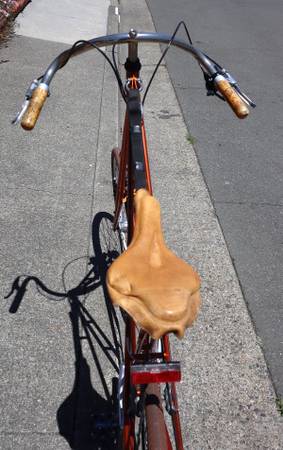
Alternative design from way, way back--See Wiki excerpts below.
I actually have two of these. I bought the first one here on CL a few years ago (see last pic) and convinced myself that since the saddle height was at the max, I needed to shop for another one! (These are sized by the length of the fork.) Turns out, the older--less shiny one--rides just as well as this one. And both fit my 6'0" frame well. I'd like to keep one of these, preferably the older ('68ish?) patina-ed one.
Extremely comfortable--this truss design began with the sling saddle, which actually sways as you're turning a corner. Your weight on the saddle actually is part of the stressed-cantilever design. It is an upright posture: Comfortable, Dutch-like, a real joy to ride, if not particularly fast or a good hill-climber--though there is a guy in the Sacramento area that competes (or did) in cyclocross races with one!
--Trigger-shifting (1 X 9 speed)
--Lighting front and rear with Son front wheel dynamo.
--Most steel tubing here is only about a half inch in diameter: This adds to the passive suspension, as well as keeping it lightweight.
From Wikipedia:
"The Pedersen bicycle, also called the Dursley Pedersen bicycle is a bicycle that was developed by Danish inventor Mikael Pedersen and produced in the English town of Dursley.[1][2] Though never hugely popular, they enjoy a devoted following and are still produced today.[3] Their unusual frame is described as pure cross,[4] was marketed as cantilever,[5] and features a distinctive hammock-style saddle. Variations include lightweight racing, tandem, and folding designs.[6][7] Other Pedersen innovations include two and three-speed internally geared rear hubs.[3]
History
Pedersen received a patent in the United Kingdom for his bicycle in the early 1890s and constructed the first model out of wood. He formed the Pedersen Cycle Frame Co. Ltd and when that fell into financial difficulties, production was continued by the Dursley Pedersen Cycle Co.[3] The design was also licensed to other manufacturers,[8] and approximately 30,000 units were produced by the early 1920s, but the design never really caught on. In 1978, Jesper Sølling resumed production in Copenhagen and has been followed by others.[9]"