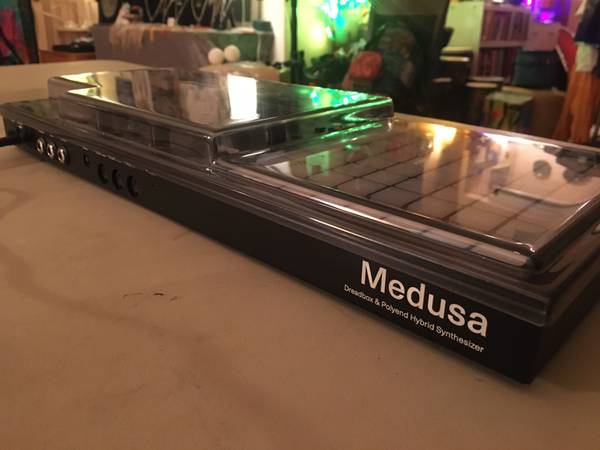
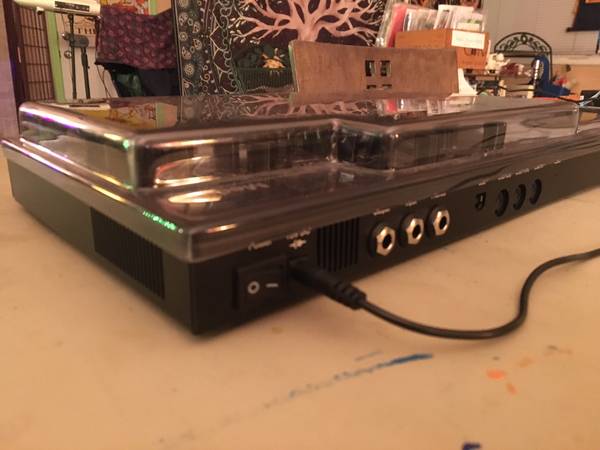
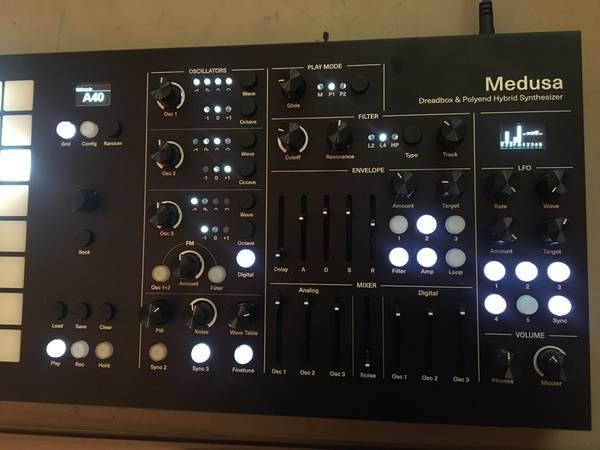
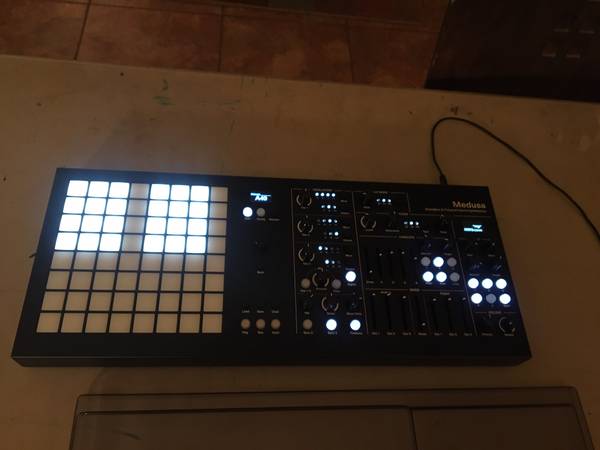
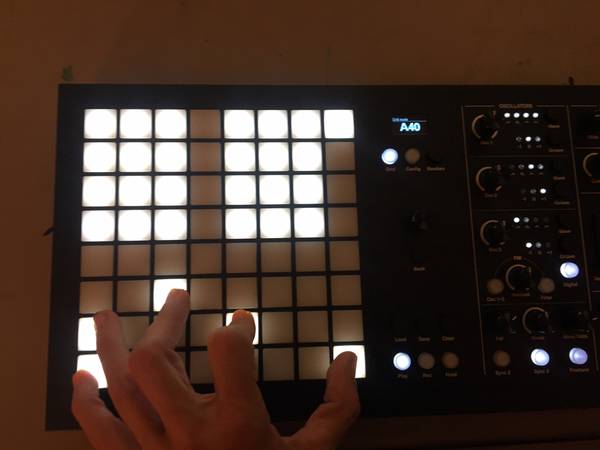
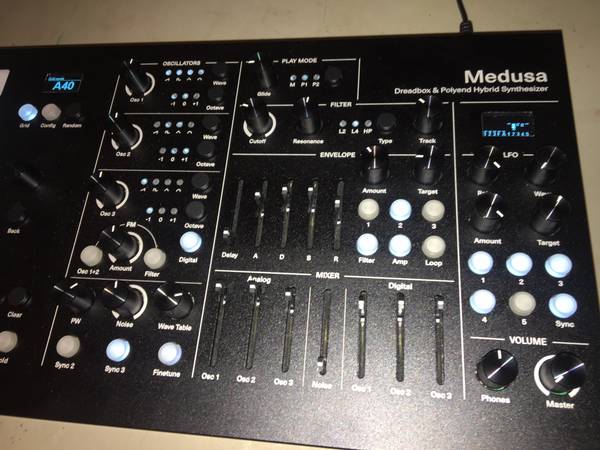
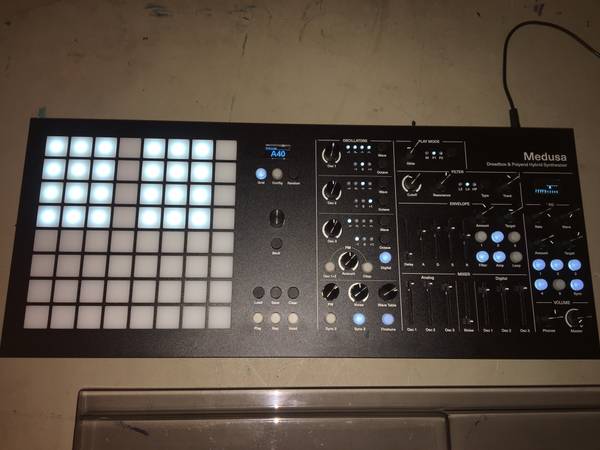
The Polyend Medusa strikes an unusual, elongated pose among tabletop synthesizers, laying across the desk like the Monolith from 2001: A Space Odyssey. A brightly lit 8x8 grid of pads covers the left side, and the six oscillator analog/digital synthesizer occupies the right hemisphere, with the preset and sequencer management section in the middle. The pads themselves offer X, Y, and Z modulation of various target destinations on the synthesizer; simply move your finger around on the last pad pressed to hear aftertouch-like effects. Two small screens are present: the central screen is the primary screen, used to set parameters and choose presets, while another dedicated screen in the allows the five [!] LFOs to be easily modified and routed to a variety of destinations. The synth case itself is stiff, feels solid, and is fairly shallow; the rear panel offers MIDI I/O, USB, phones, and monophonic audio input and output. The knobs used are fairly unusual, with caps recessed slightly into the front panel.
The synthesizer attached to Medusa presents itself initially as a monophonic synthesizer, but closer inspection reveals that it is actually paraphonic, allowing independent pitch control per oscillator, mixed down a single filter/VCA chain. The oscillators can be allocated as either six independent single oscillator voices (three analog, three digital), three dual oscillator voices or a single massive six oscillator voice—all played or sequenced directly from the Grid. The fundamental sound of the analog oscillators is good, and the digital wavetable oscillators add a welcome layer of interest to the sound. Each oscillator flows to its own dedicated VCA before being mixed down to the filter/VCA chain, allowing modulation sources like the LFOs to change the amplitude of each of the six oscillators independently! This unusual feature opens up some great sound design possibilities, allowing digital and analog timbres to phase in and out of audibility, independent of the final VCA and the tempo of the sequencer. Noise [also with a dedicated VCA] and an External In are also mixed alongside the oscillators before entering the filter.
The filter is analog, switchable between 12db lowpass, 24db lowpass and highpass settings. The sound of the filter is solid, though not particularly lively. The filter is modulated by a dedicated DADSR envelope generator, with the extra Decay stage being a helpful addition that is often overlooked on groovebox-type synthesizers. A wide range of envelope lengths can be obtained, and additional envelopes can modulate the VCA or other parameters—just hold down the dedicated button for the Envelope [or LFO!] you wish to use, and move or press the parameter you wish to modulate on the synthesizer. Voila! Your modulator now has a target!
In immaculate condition with decksaver. Will consider select trades for synths.