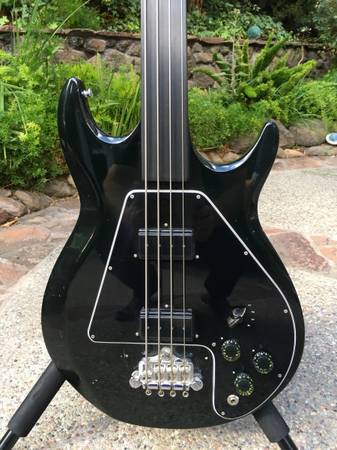
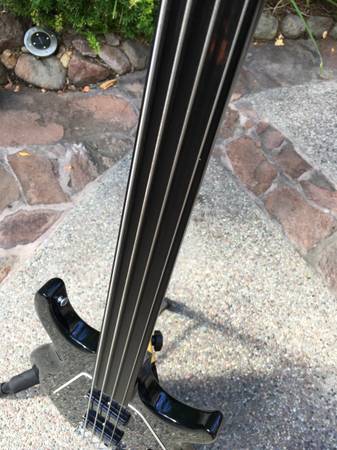
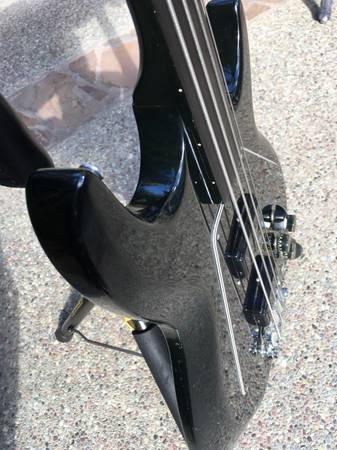
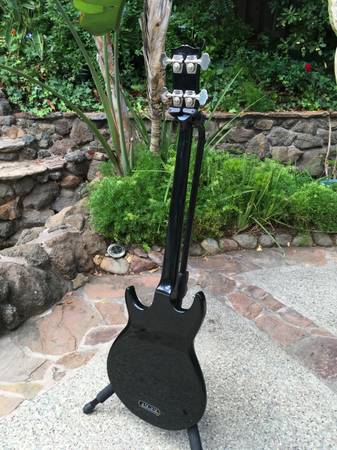
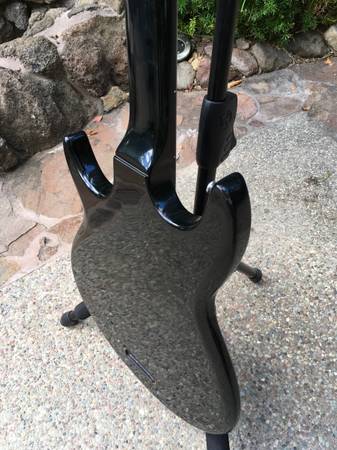
Nice condition... no original case and the bridge cover/ dampener / Handrest was removed years ago to let the strings ring out... the part has disappeared, like many of these basses, as many players preferred it removed.
The bass is clean, and polished, fretboard is oiled and amazing, and the chrome is shiny… there are a few dings, and if it bothered you, a little black glu-boost would cover them up…
This bass was produced in 1978 at Gibson's famous Kalamazoo plant, Michigan, USA (Original Rippers were only ever built in Kalamazoo), under the ownership of Norlin. This example is one of 466 Ebony Rippers produced in 1978; out of a total production of 991 shipped that year. In May 1978, the Ripper had a US list price of $559. (Which is $2840 today, adjusted for inflation…)
The Gibson Ripper looks particularly sleek in ebony finish. Only the white revealed edge of the pick guard and a flash of chrome bridge stand out from all the black: body, pickguard, pickups, control knobs...
Ebony, is of course, Gibson's name for a black finish, not a reference to the body wood, which is maple in this case. The fingerboard on black Rippers is actual ebony wood though, as opposed to the maple boards of Rippers with a natural finish.
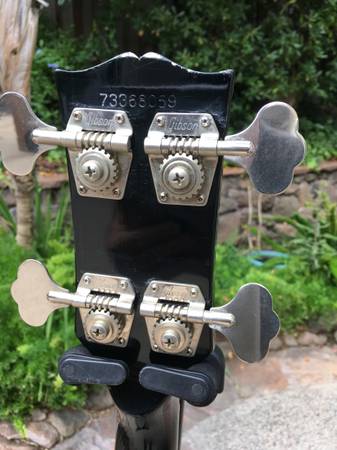
The serial number is stamped on the back of the headstock, above the Schaller BM machine heads. The serial number follows the same pattern as today's Gibson basses, i.e. 73368059 tells us that this bass was stamped on December 2nd, 1978 (day 336), at the Gibson Kalamazoo plant, and was the 59th instrument stamped that day.
Older Rippers either had six digit or eight-digit decals.
Model:Gibson Ripper L-9 SF
Year: 1978
Pickups: Two Ripper humbuckers
Scale: 34 1/2"
Body: Maple
Neck: Three piece set maple neck. Ebony fingerboard. Adjustable truss rod. 20 frets.
Width at nut: 1 5/8"
Hardware: Q-system electronics: 1 volume, 1 tone and 1 midrange control. Gibson 3-point bridge. Schaller BM tuning keys.
This is not an Epiphone or newer reproduction.
This is a great example of a late-period Gibson Ripper: note the five-ply scratch plate with pickups mounted directly onto it with three screws (older versions were mounted into the body wood itself with two screws), and the varitone numbers engraved into the pick guard… (Compare this bass to a 1976 Ripper with decal numbers on the pick guard)
Hardware fitted includes Ripper humbucking pickups, the Gibson 3-point chrome bridge, and Schaller BM machine heads. The Ripper bass can be strung from the bridge (top-loaded) using regular long (34") scale strings, or strung through the body, as this one using extra-long scale strings.
The Gibson The Ripper (or Gibson L9-S Ripper) was the product of guitar and pickup designer/builder Bill Lawrence. He worked at Gibson from 1972 onwards designing a number of similar solid bodies, such as the S-1 and L-6S. The first Gibson Ripper basses were produced in late 1973, to a good reception; 1974 was a good year and production at Gibson's Kalamazoo plant continued throughout the decade. Ripper production slowed into the eighties, with a trickle of basses being produced towards the end of 1982.
Bill Lawrence specifically designed the humbuckers and tone circuitry to accentuate the natural sounds of the guitar. A lower impedance giving clearer tones to those associated with some other Gibson bass guitars. It was also built out of maple and alder rather than mahogany and rosewood as was so often the case with previous models. These changes had a major impact on the sound and feel of the guitar; a Ripper is just not like a Thunderbird or EB bass.
The Ripper was available as a fretless and fretted bass; -the first Gibson fretless in fact- but these sold in much smaller numbers.
The controls for the Fretless Ripper are the same as on the fretted models; that is Gibson's especially developed Q-system electronics. A four-way tone selector switch, volume, mid-range and tone control.
An original DAVIES dakaware chicken head knob for the four-way switch (which is missing in some photos, but it's there!) , and speed knobs for the pots.
These controls may be a bit complicated to use, but a wide range of sounds was certainly possible... they certainly get some great sounds!
Note also that the position numbers are engraved onto the scratch plate - compared to a Ripper from pre-1977 when Gibson was still using the separate metal marker ring.
Beginning 1977 the Ripper pickups had new covers, each with three mounting screws for scratch plate mounting (rather than directly to the body wood). Furthermore, the scratch plate material was now five ply solid black-white-black-white-black - which looked especially good on ebony finished models like this one.
The black plastic pickup covers on the Ripper are slightly different from the versions produced in previous years, in that they are now scratch plate mounted with three screws, rather than screwed directly into the body wood with two screws going through the center of the pickups themselves. The coils themselves are no different. This gives the pickup a little more adjustability but also simplifies assembly of the electrical circuitry and their mounting to the body/neck.
Although the Gibson Ripper could be strung through the body for extra sustain, the Gibson three-point bridge also allows normal stringing, which some players prefer.
The string-through plate, or four-hole eyelet as Gibson describe it on the back of the Bass, replaced the four separate holes of earlier Rippers.
The Gibson Ripper has a large solid headstock, with silk-screened Gibson logo. The truss rod cover has a white revealed edge (compared to a Ripper truss rod cover from a couple years earlier... just one ply black). Tuning keys are Schaller BM.
Late seventies / early eighties Gibson basses like this are typically fitted with Gibson-engraved Schaller BM tuning keys. The volute is omnipresent on maple-necked basses of this time. The serial number is there and is an eight-digit impressed type.
The Gibson L-9SF Ripper bass guitar is a standout model with a rich history and distinctive specifications. Here's what makes it special:
Designer: Bill Lawrence, a renowned pickup and guitar designer, created the Ripper while working at Gibson in the early 1970s.
Production Years: Manufactured from 1973 to 1983, with a peak in popularity around 1976.
Purpose: Designed to compete with Fender’s Jazz and Precision basses, the Ripper was Gibson’s answer to versatile, high-performance bass guitars.
Nickname Origin: At its NAMM launch in 1972, it was dubbed the “Ripper” because it was designed to “Rip Your Ears Off” with its aggressive tone!
Technical Specifications:
Body: Typically, maple... though alder was used in 1975 for a lighter feel. Later models featured more beveling and contours for a sleeker look. Colors: Natural, Ebony, Sunburst, or Cherryburst.
Neck: Set neck construction. Made of maple, with either ebony or maple fretboards.
Pickups: Equipped with two “Super Humbuckers”, designed by Bill Lawrence for a wide tonal range.
Electronics: Featured Gibson’s Q-system electronics, including a varitone switch and multiple tone-shaping options.
Controls: Three knobs and a rotary switch allowed for various pickup combinations and tonal adjustments.
Bridge: Gibson’s three-point bridge with a cover.
Tuners: Early models had open gear tuners; later ones used Schaller BM tuners.
The "L-9S" designation in the Gibson Ripper bass guitar model doesn't stand for a specific acronym or phrase. Instead, it's Gibson's internal model code used to identify this particular instrument. Here's what it signifies:
"L" Series: Gibson used the "L" prefix for several bass models, such as the L-6S and L-5S guitars. The "L" likely refers to the series or design family.
"9": This number differentiates the Ripper from other models in the "L" series.
"S": Often interpreted as "Solidbody," indicating the guitar's construction type.
So, "L-9S" is essentially Gibson's catalog code for the Ripper bass, which was designed by Bill Lawrence and produced from 1973 to 1983.
The "L-9SF" designation refers to a variant of the Gibson L-9S Ripper bass guitar. While Gibson didn’t officially define what the “F” stands for, it's widely understood among collectors and enthusiasts to indicate:
Fretless: The “F” typically denotes a fretless version of the Ripper. These models were produced in smaller numbers and are considered rarer than their fretted counterparts.
So, the L-9SF is essentially a fretless Gibson Ripper bass, retaining the same body style, electronics, and tone-shaping versatility as the standard L-9S, but offering a smoother, gliding play style favored in jazz and funk.